

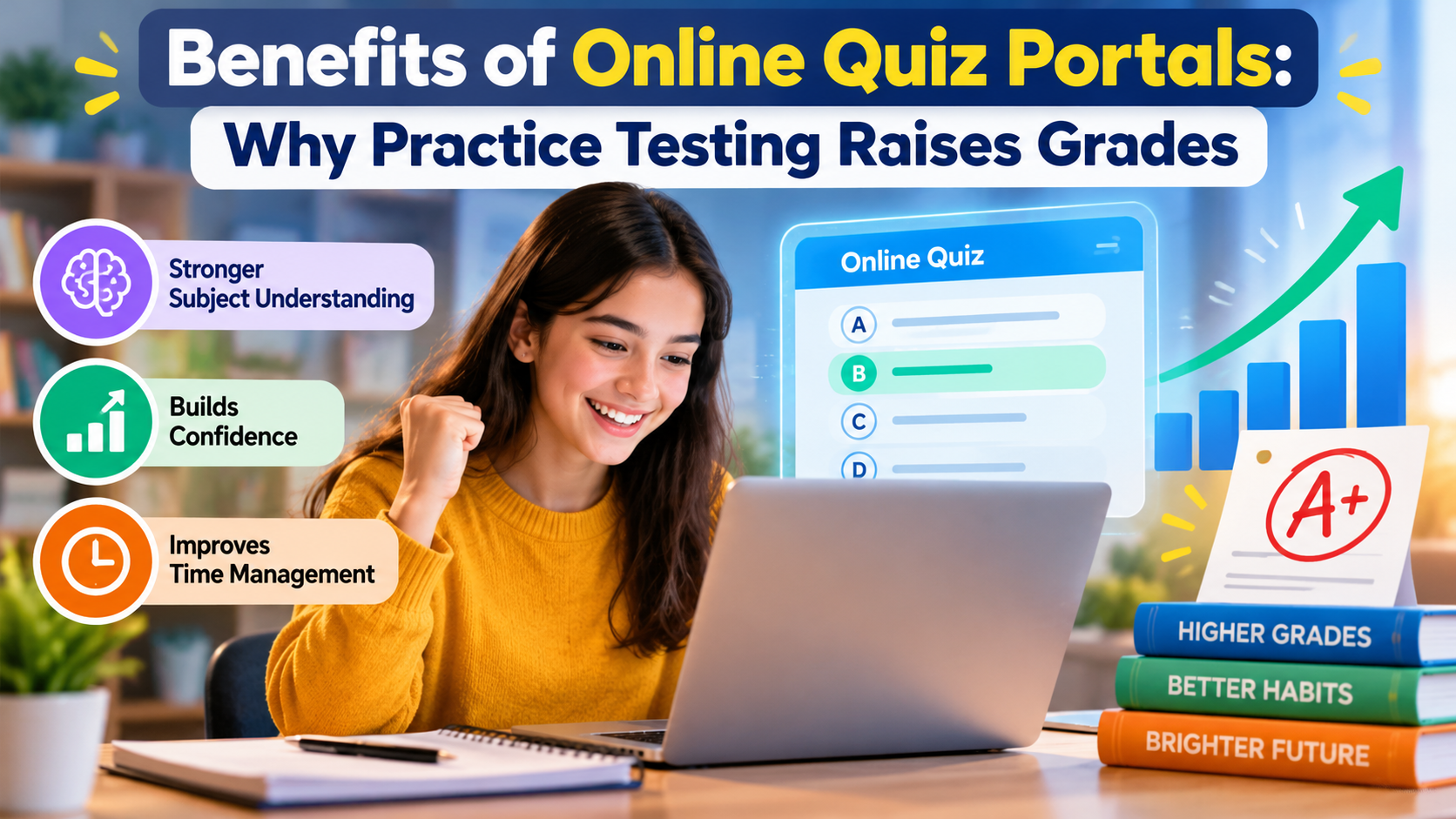
Online quiz portals help students because they turn revision into practice testing, one of the most effective study methods in learning research. Answering questions from memory, getting instant feedback and repeating weak topics over time builds stronger long-term memory than rereading notes or highlighting. The main benefits are:
- Better memory through retrieval practice
- Instant feedback, so mistakes are fixed before they become habits
- Clear data on weak topics, so study time goes where it matters
- Realistic timed practice that reduces exam anxiety
- Practice anywhere, on any device, often for free
A portal works best alongside, not instead of, official past papers, mark schemes and good teaching. If you want to see the difference for yourself, try a free five-question quiz on Quiz Portal; it takes about two minutes and needs no signup.
Studying hard is not the same as studying well
Hamza revised for his physics mock the way most of us were taught to: he read his notes three times, highlighted the important bits in yellow, then read the highlights again. By the night before, everything looked familiar. He felt ready. In the exam, the third question asked him to explain why a ball thrown upwards slows down. He knew he had read about it. He could even picture the page. But he could not pull the words out of his head and put them on paper. That gap, between recognising something and being able to recall it, catches thousands of students every exam season. Rereading builds familiarity, and familiarity feels like knowledge. Exams, though, never ask you to recognise your notes. They ask you to produce answers from memory, under time pressure. The good news is that there is a simple fix, and it is the reason online quiz portals have become one of the most useful study tools a student can have.
Why does practice testing work? The science in plain words
Practice testing works because every time you pull an answer out of memory, the memory becomes stronger and easier to find next time. Psychologists call this the testing effect or retrieval practice and it is one of the most consistently supported findings in education research. Three research findings matter most for students:
- Testing beats rereading: In a widely cited 2006 study, Henry Roediger and Jeffrey Karpicke found that students who tested themselves on a passage remembered far more of it a week later than students who spent the same time rereading it, even though the rereaders felt more confident.
- Practice testing and spacing are rated “high utility”: A major 2013 review led by John Dunlosky compared ten popular study techniques. Only two received the top rating: practice testing and distributed (spaced) practice. Highlighting and rereading were rated low utility.
- Feedback multiplies the benefit: Retrieval works best when you find out quickly whether you were right, and why. Feedback corrects errors before they set in and shows you what to study next.
A good online quiz portal is, in effect, these three findings packaged into a tool: questions that make you retrieve, instant feedback, and the ability to come back to weak topics again and again over weeks.
8 benefits of online quiz portals for students
1. They make you remember, not just recognise
Every question forces you to retrieve an answer, which is exactly the skill an exam tests. Ten focused questions often teach more than an hour of rereading.
2. Instant feedback fixes mistakes while they are fresh
With a printed past paper, you might wait days to mark it, or never mark it at all. A portal tells you immediately whether you were right and, on the better platforms, shows a worked explanation. Learning why an answer is wrong is often where the real progress happens.
3. Your weak topics stop hiding
Most students revise the topics they already like. A portal that breaks results down by topic shows the uncomfortable truth: maybe you score 90% on forces but 45% on electricity. That single piece of data can save weeks of misdirected revision.
4. Short sessions fit real life
A five-question quiz takes a few minutes, so it fits on a bus ride, between classes or before dinner. Small, regular sessions also create natural spacing, which research links to longer-lasting memory.
5. Timed practice makes the real exam feel familiar
Exam anxiety often comes from the unknown: the clock, the format, the pressure. Practising under timed conditions, in the same paper structure as the real exam, turns the unknown into routine. By exam day, you have already “been there” many times.
6. Progress you can see keeps you going
Watching a topic score rise from 50% to 80% is motivating in a way that “I read chapter 6 again” never is. Visible progress, goals and small streaks help students keep studying on days when motivation is low.
7. Free access widens opportunity
Private tuition and printed resources are expensive. A free, quality portal gives every student with a phone or laptop the same chance to practise, which matters especially for students in regions where good resources are hard to find. That is the idea behind free platforms such as Quiz Portal, which offers Cambridge IGCSE, O Level, A Level and Digital SAT practice without an account or a fee.
8. Teachers and parents get a clearer picture
Topic breakdowns make conversations easier. Instead of “How is revision going?” a parent or teacher can ask, “What happened in electricity this week?” That turns vague worry into a specific next step.
Online quiz portal vs textbook vs printed past papers
Each study resource does a different job, and the strongest revision plans use all three. A portal is best for frequent topic practice and fast feedback; official past papers are best for final exam rehearsal.
- Textbooks and notes are best for learning content for the first time. They do little for retrieval practice, give no feedback and cannot track your progress.
- Printed past papers are the best rehearsal for the real exam format and wording. They give strong retrieval practice, but marking yourself is slow, and because papers mix topics it is hard to focus on one weak area.
- Online quiz portals give strong retrieval practice with instant feedback, let you focus topic by topic, and track progress automatically. Their questions are practice-style rather than official, but they are often free and work on any device.
A simple rule: use a portal from the start of a course to build knowledge topic by topic, then shift to full official past papers in the final four to six weeks.
How to choose a good online quiz portal
A good portal is accurate, matched to your exact exam, and explains its answers. Before you commit your study time, check these six things:
- Syllabus match: questions follow your exam board, syllabus code and exam year, not a generic “science” bank.
- Worked explanations: every answer explains the method, not just “Correct” or “Wrong”.
- Topic breakdowns: results show which topics are strong and weak.
- Timed and untimed modes: untimed for learning, timed for exam rehearsal.
- Honesty about scores: practice percentages are clearly labelled as practice, not official grades or scores.
- Low barrier to start: you can try questions before handing over personal details.
The honest limits
Online portals are powerful, but they are not magic. Multiple-choice and short-answer questions cannot fully train long essay writing or practical lab skills, so you still need written practice marked against official mark schemes. Practice questions written by a portal are not official exam questions, so use official past papers for final rehearsal. And a portal only works if you use it regularly: ten minutes a day beats three hours once a month.
Ready to put the science into practice?
Pick your subject on Quiz Portal, answer five questions, and read the explanation for each one. You will know within minutes which topic deserves your next study session.
Editorial note: Research is cited by author and year (Roediger and Karpicke, 2006, Psychological Science; Dunlosky et al., 2013, Psychological Science in the Public Interest). Add links to the original papers before publishing. The student stories are illustrative composites, not real individuals.