
A clinic appointment ends, but the doctor's work often continues: finishing notes, checking medications, and updating the electronic health record (EHR). An AI scribe can draft documentation from a consultation, reducing paperwork. Yet choosing one requires more than comparing impressive demos.
Here are seven options for different clinical settings, with limitations worth understanding before sharing patient information.
What Is an AI Scribe and How Does It Work?
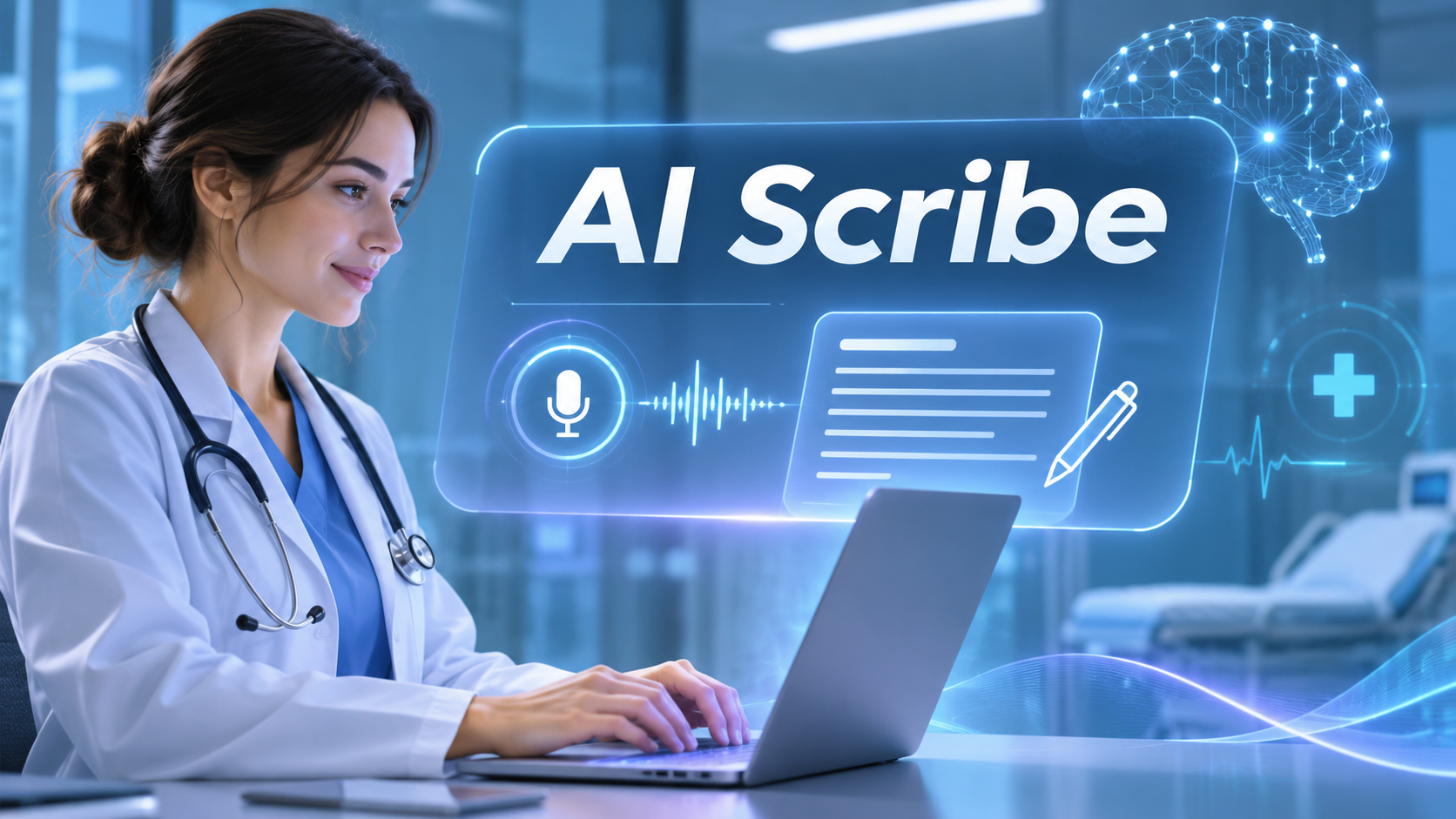
An ambient AI medical scribe listens to a permitted clinical conversation and produces a draft note. Unlike voice dictation, where clinicians deliberately speak their notes, ambient systems extract relevant details from a natural conversation. Traditional transcription generally converts recordings into text without organizing the encounter. Many tools can structure drafts as SOAP notes: Subjective symptoms, Objective findings, Assessment and Plan. But structured notes can contain errors. Clinicians must confirm diagnoses, medication details, relevant negatives, and treatment instructions before signing.
7 Best AI Scribe Tools for Doctors in 2026
1. Freed — Best for Solo Practitioners
Freed offers specialty templates and unlimited notes on its $79/month Core plan. Starter costs $39/month for up to 40 notes; Premier costs $119/month and includes EHR push for supported browser-based systems. Cheaper subscriptions may require manual note transfer.
2. Heidi Health — Best Free Starting Point
Heidi's Free plan supports unlimited transcription and standard templates, allowing clinicians to evaluate documentation without subscriptions. Advanced features and team workflows sit behind higher tiers. Verify local pricing, security terms, languages, and integrations.
3. Nabla — Best for Multilingual Workflows
Nabla provides ambient documentation, dictation, and EHR-integrated workflows, with structured notes that can adapt across specialties and languages. Its enterprise-focused integration options include Epic and athenahealth. Ask for a quote and test your clinic's actual languages, accents, and note formats instead of assuming accuracy.
4. Abridge — Best for Large Health Systems
Abridge supports enterprise documentation directly in EHR workflows, including Epic. Its Linked Evidence feature helps clinicians trace generated statements back to encounter conversations. Implementation and pricing are organization-specific. Hospitals should evaluate governance, training, and note-validation demands.
5. Suki — Best for Broader Clinical Tasks
Suki extends beyond note drafting into pre-visit summaries, voice-enabled work, coding suggestions, and order staging. It describes workflows across major EHRs, including Epic and Oracle Health. These capabilities may suit busy multi-provider practices, but confirm availability and pricing.
6. Microsoft Dragon Copilot — Best for Enterprise Voice Workflows
Dragon Copilot combines ambient documentation with dictation, clinical information retrieval, and workflow assistance. It targets clinicians across different care settings and supports integrated documentation. Licensing depends on configuration; request a quote and check EHR compatibility.
- DeepScribe — Best for Specialist Clinics
DeepScribe focuses on complex specialty documentation with demanding terminology. Its specialty-oriented approach can appeal to oncology and cardiology teams. Pricing is quote-based; verify integration scope, specialty templates, and how the system handles unusual terminology during a supervised pilot.
How to Choose the Right Medical Scribe Software
Start with a small, consented pilot and compare the entire encounter-to-chart workflow—not just transcription quality. Use this checklist:
- Accuracy: Check medical terminology, medication doses, omissions and unsupported statements.
- Integration: Confirm whether notes flow into your actual EHR fields or require copying.
- Privacy: Review encryption, access controls, data retention, deletion, and vendor training policies.
- Compliance: For applicable US workflows, evaluate HIPAA obligations and a Business Associate Agreement (BAA); follow local rules elsewhere.
- Cost: Include subscriptions, integrations, onboarding and time spent correcting drafts.
Explore more AI tools for healthcare and clinics on AI App Space.
Real Clinical Workflow: Benefits and Limitations
Consider a hypothetical primary care physician seeing several patients with overlapping symptoms. Instead of completing every SOAP note from memory afterward, the doctor uses a consented ambient tool to prepare drafts during appointments. After each visit, they correct a mistaken medication dose, add an omitted examination finding, and approve the final note in the correct patient chart. The tool helps with drafting; the doctor remains responsible for accuracy. A randomized clinical trial found reduced note-writing time with Nabla, but not a statistically significant reduction with the tested DAX version. Researchers also reported occasional inaccuracies. Benefits therefore depend on the tool, clinician, and workflow.
Final Verdict
Try Heidi for a free starting point or Freed for individual practice needs; evaluate Nabla, Abridge, Suki, Dragon Copilot, or DeepScribe against organizational workflows. Prioritize patient safety over automation promises.